





If you’re wondering how to prepare the subgrade for concrete slabs, it’s worth understanding the entire process, regardless of whether you’re using concrete slabs for a patio or for other purposes. Below we present the steps that will help you prepare the subgrade effectively and efficiently.
Stage 1: Assessing the terrain and choosing materials
How to assess the terrain for construction?
An important element is a precise assessment of the terrain. Pay attention to soil compaction requirements and any potential obstacles. Careful planning at this stage can ensure the success of further work.
Choosing the right building materials
When choosing concrete slabs, keep their quality and intended use in mind. Also don’t forget about additional materials, such as sand or aggregate, which will be needed to prepare the subgrade.
Stage 2: Marking out the area and preparing the ground
Marking out the construction area
It’s helpful to use a string line to mark out the area that will be covered with concrete slabs. This is essential to ensure proper preparation and an even surface.
Preparing the subgrade and removing vegetation
Remove all unnecessary plants, roots, and stones. Then excavate the soil to the appropriate depth and add a layer of aggregate for stability.
Stage 3: Stabilizing underlay and compaction
Choosing and laying the stabilizing underlay
A stabilizing underlay is essential for the long-term durability and stability of concrete slabs. It should be properly matched to the type of soil as well as the type and magnitude of the load.
Compacting the ground under the concrete slabs
Compaction helps minimize future settling and ensures a stable base for the slabs. This can be done manually or using a compaction device.
Stage 4: Installing the concrete slabs
Methods for installing concrete slabs
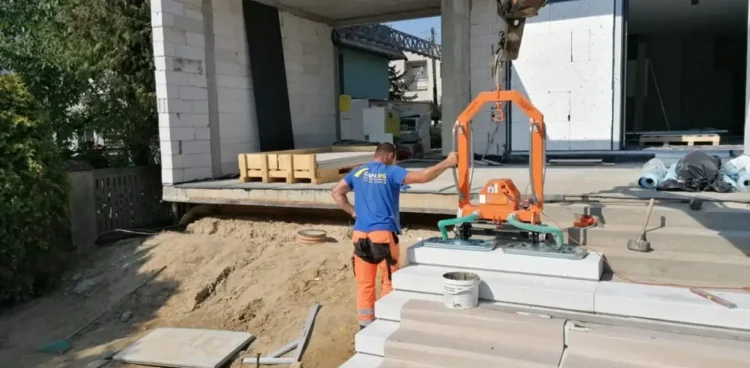
Slab installation can be carried out manually or using equipment such as a vacuum lifter or a vacuum lifter for stone slabs. The choice of method depends on the size and weight of the slabs. In addition, lifters work great for pulling up a slab in situations where the subgrade needs to be leveled. Such devices are available in VIAVAC’s product range — we offer only proven equipment, distinguished by reliability and intuitive operation.
Leveling and checking the grade
When laying concrete slabs, it’s important to simultaneously monitor and maintain the proper level. This ensures an even and stable surface.
Stage 5: Filling the joints and final finishing
Filling the joints between the slabs
Joints between concrete slabs are usually filled using sand or concrete mortar. Filling the joints helps ensure stability and protects the surface from water penetration.
Thorough surface finishing
Thorough cleaning and finishing of the surface is important for maintaining the aesthetics and durability of the concrete slab covering.
Summary
A properly prepared subgrade for concrete slabs guarantees stability, durability, and an attractive end result. Remember to carry out each of the above stages carefully, and your concrete slabs for a patio or other surface will serve you well for many years. Good luck!